NOLA History: The 1929 New Orleans Streetcar Strike

by Edward on July 20, 2011

in History

New Orleans is usually well-known for its warm, beautiful summers, but the summer of 1929 was exceptionally hot, sticky, and violent, because of a transit strike. In a time when more people depended on public transportation, the strike was a serious blow to downtown businesses and the company operating the city’s transit system. It did have a bright side, though, as one of New Orleans’ most notable culinary delights, the po-boy, was invented in the midst of the strike.

The history of the New Orleans Streetcar Strike in 1929

Burned and damaged streetcars, casualties of the 1929 strike (HNOC)

Contract talks between the Carmen’s Union and New Orleans Public Service, Incorporated (NOPSI), had been on-going through the spring of 1929, and came to an impasse by the end of June. The union was looking for better hourly wages for motormen and conductors, and NOPSI was looking to break the union. The union walked off the job on July 1, 1929, and NOPSI almost immediately implemented contingency plans. The company began to operate “jitney buses” on Canal Street to Uptown, in an attempt to continue some transit service. By July 5th, NOPSI had a plan in place to break the strike.

On the morning of July 5, 1929, a single “Palace” model streetcar left the barn on Canal and N. White Streets. It was operated by a non-union motorman. The streetcar slowly made its way from Mid City into the Central Business District (“CBD” in NOLA-speak). The slow pace of this streetcar was mainly because strikers and their sympathizers damaged the right-of-way, either ripping up the tracks or placing obstructions of various kinds on the rails. Non-union workers walked along, clearing the debris as the streetcar moved forward. By the time the streetcar made it to Faubourg Treme, a crowd of pro-union men was also walking alongside. The crowd grew and grew, but the streetcar was allowed to continue on until just before Liberty Place, located at the foot of Canal Street. There was a multi-track layover area just before the loop around the Liberty Monument, and this particular streetcar came to a stop in that layover area. (The specific location of this track section would be right where the three-track section in front of One Canal Place is now.)

New Orleans streetcar strike of 1929

Canal Street, devoid of streetcars, early July, 1929 (HNOC)

As the pro-union crowd surrounded the streetcar, the non-union motorman and his colleagues abandoned it and fled the area. The crowd pressed in close to the streetcar, which is most likely how it began to rock back and forth. The 1915-vintage “Palace” cars were built by the American Car Company of St. Louis, MO. They were wider, thereby offering a more comfortable ride, than the 1923-vintage Perley A. Thomas cars, the “green streetcars” so famous in New Orleans. In spite of being wider and a bit longer, the crowd’s force caused the streetcar to turn over on its side. Shortly after that, someone set the streetcar on fire, causing the crowd to disperse.

In all, five streetcars were torched/destroyed during the strike: “Palace” cars 679, 687, and 696, and “Morris” trailer cars 523 and 524. After July 8, 1929, NOPSI did not try to use strike-breakers to restore streetcar service, but did continue to operate the jitney-buses.

The streetcar strike of 1929 in New Orleans Louisiana

Union supporters overturn a tow truck going to recover a damaged streetcar, July 8, 1929 (Photo courtesy of H. George Friedman)

Labor strikes are hard on both employer and employee. On the employer side, the 1929 strike did serious damage to NOPSI’s reputation and business. The company lost four million riders in 1929, forcing the conversion of Coliseum, Dryades, Tchoupitoulas, St. Bernard, and Southport lines to bus service. (Southport was an Uptown line on Oak Street.)

On the employee side, motormen, conductors, and their families suffered serious economic hardship. The union walked out on July 1st, and the men didn’t return to work until October. One thing they had going for them, though, was a lot of support from the community. In particular, the assistance of one pair of brothers, Clovis and Bennie Martin, was invaluable. The Martin Brothers came to New Orleans and got jobs as motormen around 1910. By 1929, they owned and operated their own restaurant in Mid City, and were in a position to help the strikers.

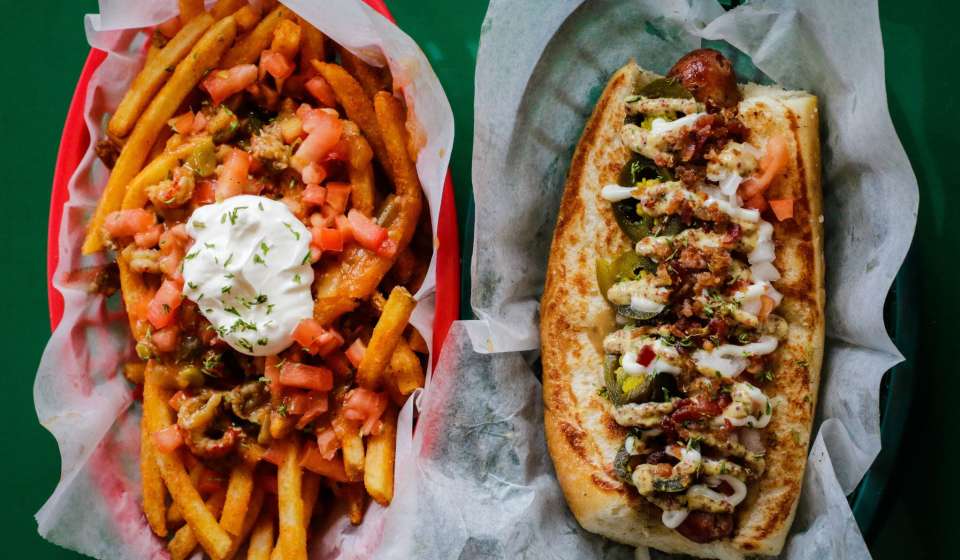
Not only could the men on the picket lines not afford to buy lunch, they’d have to abandon their pickets to go get food. The Martins contacted local bread baker John Gendusa, to get Gendusa’s to make a loaf of bread that was longer and narrower than what they were selling at the time. Martin Brothers would slice the new loaves down the middle, load them up with fried potatoes and roast beef gravy, and cut them up into 12”-15” sections. They’d then wrap up these “poor boy” sandwiches and bring them out to the picket lines. Thus, the New Orleans po-boy was born. You can still get a good french fry po-boy at many of the city’s great sandwich places!

FREE Weekly Roundup!

Enter your email address for updates on all the best things happening in New Orleans.

Previous post:

Next post: